


DEcision making approaches
All answered must be typed using Times New Roman (size 12, double-spaced) font. No pictures containing text will be accepted and will be considered plagiarism).add APA references—————————————————–Read the above Article and answer the following Questions:
Question 1: Explain the decision making approach discussed in this Article (300-400 words)
Question 2: Why sustainable supplier selection is a typical multi-criteria decision-making problem involving subjectivity and vagueness? (150-200 words)Question 3: Why Supplier selection decisions are important for most of the manufacturing firms, as discussed in this study? (150-200words)Question 4: What is your opinion about this study and how it is linked to course and beneficial for you? (150-200 words)
Answers:
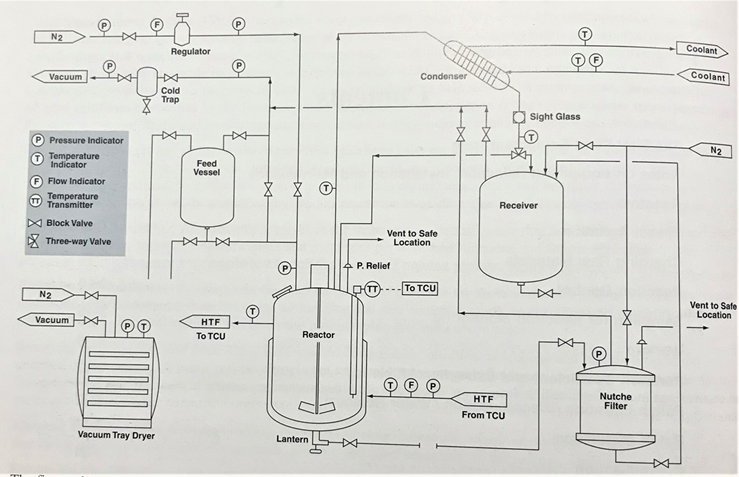
upstream and downstream process
- A process is to be run at a scale of 1.Y m3 in a vessel with an 1XY rpm fixed speed retreat curve impeller with a diameter of 0.5 m. Determine the impeller diameter if rotational speed has been doubled and we intend to mimic power number. XY are the last two digits of your student ID. ρ = 1000 kg/m3, µ = 0.001 kg/m.s [6]
- On the following process diagram, label upstream and downstream processes. (it can also be reported in a table) [6]
- Describe different methods of sampling from a process. Which method is preferable, why? [4]
- Explain IQ and OQ protocols. [4]
Disaster recovery plan
HEAD 1: Disaster recovery plan for an organization
Develop a disaster recovery plan for an organization. There are many different templates available online for you to use as reference and guidance. Your plan should cover the following sections (these sections detail the elements in a DR plan in the sequence defined by industry compliance standards ISO 27031 and ISO 24762):
Important: This section should summarize key action steps (such as where to assemble employees if forced to evacuate the building) and list key contacts with contact information for ease of authorizing and launching the plan.
Introduction
Roles and Responsibilities
Incident Response
Plan Activation
Document History
Procedures
HEAD 2: Explanation
Web server auditing can go a long way in enforcing tighter security and ensuring business continuity. The power of log data is tremendous. Web server logs record valuable information pertaining to usage, errors, and other important security events. Using a specialized auditing tool can be extremely helpful during the audit of web servers. In your discussion this week, please discuss the methods of identifying weak web server configurations and how to mitigate them for a secure web server. Possible concepts to include are SSL certificates, HTTPS usage, attack surface, SQL injection, vulnerability migration, and least privilege. In at least one of your peer responses, provide an overview of how to audit the web server’s security and implement best practices.
(Remember, APA is double spaced)
Be approximately six pages in length, not including the required cover page and reference page.
Follow APA 7 guidelines. Your paper should include an introduction, a body with fully developed content, and a conclusion.
Support your answers with the readings from the course and at least four scholarly journal articles to support your positions, claims, and observations, in addition to your textbook. The UC Library is a great place to find resources.
Be clearly and well-written, concise, and logical, using excellent grammar and style techniques. You are being graded in part on the quality of your writing.
What are the predicted effects of additional undergraduate students
This assignment is worth 20 points in total. It is composed of 2 parts: Part 1 – Multiple Choice (15 points, 3 attempts, no time limit) There will be 15 multiple choices. Each question is worth 1 point. Part 2 – Code and Code Output (5 points, unlimited attempts, no time limit) You need to present both code and code output for each question in order to receive full 10 points. Upload your code under Assignments – Homework 4 (Upload Your Code Here) . I accept html, word, or pdf file. Problem 7.20 In this exercise, we will explore some of the factors predicting costs at American universities using the data file poolcoll2 and observations outside the great recession. Let: TC = the real ($2008) total cost per student, FTUG = number of full-time undergraduate students, FTGRAD = number of full-time graduate students, FTEF = full-time faculty per 100 students, CF = number of contract faculty per 100 students, FTENAP = full-time nonacademic professionals per 100 students. Quesiton 1: Estimate the regression of ln(TC) on the remaining variables. What are the predicted effects of additional undergraduate students? Note that measurement for variable FTUG is per 1000 students, not per student (round to 2 decimals) Quesiton 2: Based on the results in Question 1, what are the predicted effects of additional graduate students on total cost per student? Note that measurement for variable FTGRAD is per 1000 students, not per student (round to 2 decimals) Question 3:
ECON 123A: ECONOMETRICS I Homework 4 (Due: November 30 Tuesday at 3 pm, Pacific Time)
Based on the results in Question 1, what are the predicted effects of additional full-time faculty, contract faculty, and nonacademic professionals on total cost per student? (round to 2 decimals) Question 4: Add the indicator variable PRIVATE to the model in Questions 1. Provide the estimated model. (round to 4 decimals) Question 5: Do you predict higher or lower total cost per student at private universities? Is this a statistically significant factor in predicting total cost per student? (use integer) Question 6: Estimate the model in Question 1 twice, once for private universities and once for public universities. Call the sum of squared residuals for the private universities SSE1, and the sum of squared residuals for the public universities SSE0. Report values for SSE1 and SSE0. (round to 4 decimals) Quesiton 7: Add to the model in Question 1 not only PRIVATE but also PRIVATE times all the other variables. Call the sum of squared residuals from this model SSE2. Report value for SSE2. (round to 4 decimals) Question 8: Compare SSE1 + SSE0 to SSE2. What do you conclude? (round to 4 decimals) Problem 7.23 In the STAR experiment (Section 7.5.3), children were randomly assigned within schools into three types of classes: small classes with 13–17 students, regular-sized classes with 22–25 students, and regular-sized classes with a full-time teacher aide to assist the teacher. Student scores on achievement tests were recorded as well as some information about the students, teachers, and schools. Data for the kindergarten classes is contained in the data file star5_small2.csv . Consider the regression: (equation (A)) Question 9: Estimate the regression model in equation (A), where AIDE is an indicator variable equaling 1 for classes taught by a teacher and an aide, and 0 otherwise.Test the statistical significance of at the 5% level. (round to 4 decimals) Question 10: Add the additional explanatory variable TCHEXPER in equation (A). Does its addition to the model affect the estimates of and ? (round to 4 decimals) Problem 7.30 MATHSCOR = + SMAL + AID + Ei β1 β2 Li β3 Ei ei β3 β2 β3
What effect does having public health insurance have on the number of doctor visits a person has during a year? Using 1988 data, rwm88.csv , from Germany we will explore this question. Question 11: Construct a histogram of DOCVIS (use 9 bins for the histogram). How many doctor visits do most patients in the survey have during the year? (use integer) Question 12: Based on the results in Question 11, what are the mean and median number of doctor visits? (round to 2 decimals) Question 13: Based on the results in Question 11, what is the 90th percentile? (use integer) Question 14: Estimate the regression model with dependent variable DOCVIS and explanatory variables FEMALE, HHKIDS, MARRIED, SELF, EDUC2, HHNINC2. Comment on the significance of these predictor variables. Question 15: Estimate the regression model with dependent variable DOCVIS and explanatory variables FEMALE, HHKIDS, MARRIED, SELF, EDUC2, HHNINC2 separately for those with public insurance (MODEL 1) and those who do not have public insurance (MODEL 2). Compare the coefficients from the two models.
Bipolar disorder
1) Do you think John Brown suffered from bipolar disorder in a way that contributed to his actions? If so, what evidence convinced you that he did? If not (or if you don’t think there is enough evidence to make a case for it), what convinced you of your position?
2) Does it matter, historically, whether he suffered from bipolar disorder? In other words, does it matter why he was driven to do what he did? Or is the action at Harper’s Ferry itself (and its consequences) the only thing we need to consider truly historically important?
Please note: this discussion is not asking you whether you believe John Brown was “crazy” or “insane.” It is asking you to determine whether we have enough evidence to convincingly argue that he suffered from a specific form of mental illness (bipolar disorder) and if so, whether it may have been an important factor in his decision to attack Harper’s Ferry. Since it is estimated that up to 4.4% of Americans will suffer from some form of bipolar disorder at some point their lives, it is likely that some of your classmates in this class have experienced it, and even more likely that some of us have loved ones or close friends with the disorder. Therefore, I will expect all of you to discuss this issue maturely and sensitively.
calculate your own carbon footprint based on your energy consumption, diet, and lifestyle choices
Met 112: Calculate your Carbon Footprint
Due: Tuesday, November 30th, 2021 (at 11:59 P.M.)
Submit a brief discussion response
Email or see me in office hours if you have questions.
FIRST, calculate your own carbon footprint based on your energy consumption, diet, and lifestyle choices using one of the following websites.
- Global footprint network (Links to an external site.) (https://www.footprintcalculator.org/home/en)
- The Nature ConservancyLinks to an external site. (https://www.nature.org/en-us/get-involved/how-to-help/carbon-footprint-calculator/ (Links to an external site.))
- The (Links to an external site.) EPA (Links to an external site.) (https://www3.epa.gov/carbon-footprint-calculator/ (Links to an external site.))
SECOND, briefly (in 3-5 complete sentences) reflect on the various mitigation strategies
- Reducing your personal carbon footprint
- International governance
- Technological solutions
In your reflection you many answer questions such as….How did you feel about calculating your own carbon footprint? … Do you have areas you can reduce your emissions? … Which mitigation strategies are you most and least optimistic about? … Other thoughts and feelings you have about climate mitigation.
strategic management project
I want you to provide a feedback for two reports about Scenario-Based Strategic Management Project , each report is around 6 pages, double spaced. (I’ll attach them in the chat).
Requirements:
– not less than 4 comments on each report explaining what they should improve, each comment not less than 40 words.
– add a final comment summarizing all the feedback and what they should improve.
– Use the comment tool in word docs.
Event Analyses on Environmental Studies
Hello, I need help with 1 short paper and 2 Event Analyses on Environmental Studies, which are Due on December 3rd, 11:59 pm (Pacific Time). SO TOTAL WORK WOULD BE 3 ASSIGNMENTS.
I’ll provide the readings and lectures that you can use for the questions when we start the conversation. Also, I can send you the answer (written work) that I got 93/100 from the previous one.
Everything is mentioned, so please read the questions carefully.
I have many questions regarding this course so I can meet an outstanding tutor so I can work frequently; thank you.
—–1st ASSIGNMENT—–
This is an open book, open note. Answer 2 of the following 3 questions on a typed, double-spaced document (font size must be no smaller than 10). You must answer question #1, so your choice for your second essay is between #2 and #3. You are to complete this essay examination outside of class and upload it on GauchoSpace no later than 11:59 pm Pacific Time on December 3, 2021. These are essay questions, so take your time and answer them thoroughly with supporting evidence from the readings, class lectures, discussions, and films. The length of each answer should be a maximum of 3 double-spaced pages (which means the total length of the both questions combined should be no more than 6 double-spaced pages). Please make sure your text font is no smaller than 10 points and that your margins are no smaller than ½ inch. You can earn a maximum of 25 points for this exam (12 points for each question and 1 free point). I will be looking for one basic criterion: a strong argument supported by evidence from class sources. Please make sure you include the letters below (for example, 1A, 1B, etc.) in your essays to indicate clearly which questions you are answering. Also, please answer all parts of the question and do so in a way that advances a clear argument (in other words, make sure you have a clear point). Please do not quote directly from the readings: use your own words. Be sure to draw directly from both readings and lectures. Finally, include all references to readings in parentheses like this: (de Onís, p. 6) or (Lecture, November 9, 2021). There is no need for a bibliography. Good luck!
[note: you must answer question #1]
1. A) In “Alternatives for Community and Environment” Julian Agyeman argues that there are some key reasons for the success of ACE (Alternatives for Community and Environment). Isabelle Anguelovski’s study of social change in Boston, Havana, and Barcelona (“Tactical developments for Achieving Just and Sustainable Neighborhoods”), also focuses on how grassroots movements can achieve successes for promoting environmental justice and sustainability. Identify and discuss three ways these authors are in agreement over what the drivers of success are for these efforts (6 points)
B) Our special guest lectures (Eco-Vista, Carlos Orendain, Teresa Romero, etc.) described the actions of environmental and climate leaders in this region and other sites around the U.S.. What are some major lessons you learned from at least 1 of these sources about the most effective means to achieve ecological sustainability? We were introduced to the following concepts this quarter—degrowth [Kallis et al], ecological design [Lecture], and regeneration [Lecture and Hoxie]. Choose 1 of these concepts and discuss how it was reflected in any 1 of the guest lectures (6 points)
2. A) We were introduced to the following concepts this quarter–resilience [Ranganathan and Bratman, Lecture, Caniglia et al], regeneration or regenerative development [Lecture, Hoxie], and social sustainability [Ergas]. Drawing from course materials, discuss how any 2 of these concepts push beyond the limitations of sustainability or sustainable development. In other words, why and how do these concepts take us a step further? (6 points)
B) Drawing on key sources from the course, discuss and provide evidence for why COVID-19 is a concern that reflects the intersections of social equity and environmental risks. What might be a solution to these challenges that reflects one or more key ideas from the course readings (for example, multi-species justice, wasteocene, etc.)? (6 points)
OR
3. A) You proposed your own Green New Deal during the Quiz 2 this week. How does your Green New Deal compare to at least 2 other Green New Deals we have encountered in the class? In other words, what does your Green New Deal offer that others do not offer? Finally, how does your Green New Deal specifically address at least 2 key ideas from the readings in Week 8, Week 9 or Week 10 (for example, commons, cooperatives, energy justice, resilience, Ubuntu, degrowth, etc.)? (6 points)
B) Drawing from Agyeman’s “Alternatives for Community and Environment” article, what is the Just Sustainability Index (JSI) and how well do most U.S. environmental organizations perform when evaluated by this index? Offer a critique of the JSI—in other words, how might this index be limited in some way? Propose a way to strengthen or improve the JSI. That improvement should include some consideration of key concepts from other readings assigned this quarter. (6 points)
—–2nd & 3rd ASSIGNMENT—– (Event Analysis 1 & 2)
You can do a movie and a webinar if you cannot find a live event. I would recommend tapping into the Isla Vista community to find events relevant to local issues. You can google non-profits or interesting organizations like The Nature Conservancy, or something like Green Biz. You can also watch a movie like Artifishial or DamNation.
These are just a few general ideas, but please let me know if you have any others.
This assignment requires you to write up a 1 page single-spaced summary and analysis of an event that you observed and/or participated in. You can write up an event analysis for a relevant film as well, but that can only be for 1 of the 2 assignments. The goal is to have you engage in writing and thinking about relevant activity and creative work going on in the world and to relate it to the class. You can receive a maximum of 2 points for each event analysis (and up to .25 and .50 points off for incomplete responses). There are two things that each event analysis must include: 1) a short summary of the event (1 point maximum); and 2) an analysis of how the event relates to the class (1 point maximum). If you include any sources, please list those at the bottom of your essay using APA style (https://www.mendeley.com/guides/apa-citation-guide).
Label the Toulmin Argument parts
Rogerian Argument Rebuttal Essay
Introduce a current topic that is significant in the world.
Provide context on your topic and clearly explain a reasonable, commonly accepted claim that has been made regarding this modern issue. Use key terms such as claim, warrant, and support/evidence from the Toulmin argument format in your explanation. Be sure to provide relevant contextual evidence in support of the claim.
- Label the Toulmin Argument parts
- Briefly provide relevant contextual support
After you have clearly established the validity of your initial claim, convince your audience that it is incorrect. Utilize any means of persuasion that will radically change the perspective of your audience.
- Address the problems of the opposing side and explain how your new perspective helps to fix them.
- Use persuasive technique and additional contextual support to prove your opposing perspective.
A common strategy of a Rogerian Argument is to make the opposition feel as though they would benefit by adopting your new counter-claim rather than flat out rejecting their point of view. In order to convince your opposition you often have to persuade them in a way that does not necessarily invalidate their ideas. You catch more flies with honey. The ultimate goal of this essay is to successfully change the mind of a reader who fully supports the initial claim you are refuting.
Essay must be MLA formatted including in-text citations and a works cited page
Use at least 2 sources from 2020 or later
2 Pages, typed double-spaced
social media among political leaders
Social media is highly popular among political leaders. This Pew dataset provides details of the social media activities of US Congress members who started their term after January 2019. Please use this dataset to answer the questions below.
Your submission should include (1) a Word file with your answers and (2) a .R file with the code you write to carry out the analysis.
Q1. How many Democrats and Republicans in Congress are on Facebook and how many are on Twitter?
Q2. On average, which party’s members are likely to have more:
a) Followers
b) Average Reactions
c) Average Shares
Please provide the averages under each category for each party along with the significance levels for comparison.
Q3. On average, which platform is likely to yield more:
a) Followers
b) Average Reactions
c) Average Shares
Please provide the averages under each category for each platform along with the significance levels for comparison.
Q4. Is there a statistically significant correlation between:
a) Total Posts and Average Reactions
b) Total Posts and Average Shares
c) Average Reactions and Average Shares
Please provide the Pearson’s r coefficient and significance levels of each correlation.


