


What is the difference between rebasing and merge in Git?
Recruiter Screening Questions
Question #1: How would you join Tables A and B together in order to retrieve names with no matches in the opposing tables?
Table A
| Name | ID |
| Jon | 1 |
| Jacob | 2 |
| Jingleheimerscmidt | 3 |
Table B
| Name | ID |
| Paul | 1 |
| Jacob | 2 |
| Jingleheimerscmidt | 3 |
Question #2: From this table we need to keep the newest version of each record using date_added, but would like to keep the oldest this_flag value. All fields, minus date_added and this_flag, are used to determine the uniqueness of a record. How would you go about doing this and what would the end result look like?
| Date_Added | this_flag | Name | DOB | ID |
| May 1st , 2015 | Y | Jingleheimerscmidt | 19901002 | 3 |
| May 1st , 2015 | N | Jingleheimerscmidt | 19901002 | 3 |
| May 5th, 2015 | Y | Jon | 19901001 | 1 |
| May 1st , 2015 | N | Jon | 19901002 | 1 |
| May 1st, 2015 | Y | Jacob | 19901001 | 2 |
| May 5th, 2015 | N | Jingleheimerscmidt | 19901001 | 3 |
| May 1st, 2015 | Y | Jingleheimerscmidt | 19901001 | 3 |
Question #3: For the table given in Question #2, can you give an example fixed width file layout for this table? Also, do the same for XML and CSV.
Question #4: There are 2 fields coming in on a file and we need to verify that the values populated are valid, without explicit direction from business. The two fields are DOB (YYYYMMDD) and SSN (000000000).
Step 1: List the rules you would create to ensure those fields are properly validated.
Step 2: Provide code to create those rules in whatever language you are most comfortable with (though SQL preferred for verification reasons).
Question #5: What is the difference between rebasing and merge in Git?
Question #6: You have just made a commit and found critical issues with the new version, how do you restore back to the previous version?
Question #7: Your team has been working on a new release, you are being tasked with combining and merging all the changes for the next release. Based on the following graph, what series of steps would you take to get to Master 2.0 while including all branches.
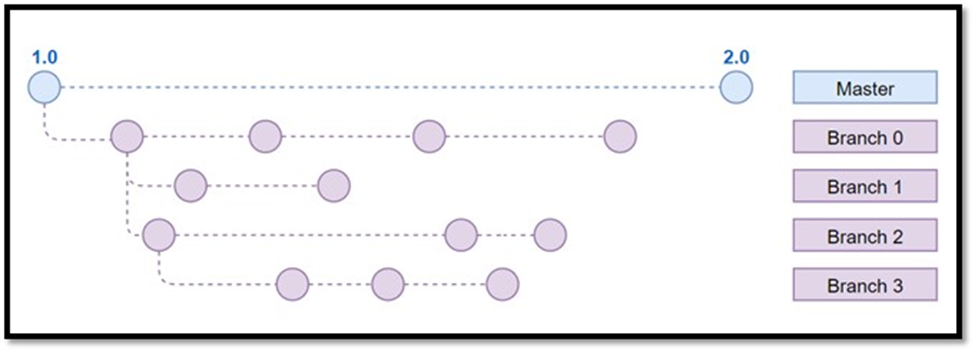
Question #8: We would like to migrate our sales report to run on the Azure Computing network, the effort to run these reports is as follows:
| Schedule | Regions | Expected Volume | Expected Load |
| Daily | All | At least 15,000 Transactions | Low |
| Weekly (Friday 11PM) | North America, Asia | 60,000 to 150,000 Transactions | Low but varies heavily |
| Monthly (Last Day of Month) | All | 400,000 to 800,000 Transactions | High with high variation |
| Bi-Weekly (Wednesday Update to Management) | North America | At least 250,000 Transactions | Low |
| Quarterly (1st Day of Quarter) | All | Millions or more | Very High |
What kind of Computing Solution would you recommend to use to allow for these report to run with an acceptable level of cost and performance, explain your reasoning
Write a short memo to Kevin Semcken explaining what he should do before he approaches potential lenders and investors to maximize his chances of getting the capital that Able Planet needs.
| Kingdom of Saudi Arabia Ministry of Education Saudi Electronic University | المملكة العربية السعودية وزارة التعليم الجامعة السعودية الإلكترونية |
College of Administrative and Financial Sciences
Assignment-3
MGT402 – Entrepreneurship and Small Business
Deadline: 04/12/2021 @ 23:59
| Course Name: Entrepreneurship and Small Business | Student’s Name: |
| Course Code: – MGT 402 | Student’s ID Number: |
| Semester: I | CRN:13363 |
| Academic Year: 1443/1444 H |
For Instructor’s Use only
| Instructor’s Name: Dr. Asif Hasan | |
| Students’ Grade: Marks Obtained/Out of | Level of Marks: High/Middle/Low |
Instructions – PLEASE READ THEM CAREFULLY
- will NOT be accepted.
Assignment – 3
Entrepreneurship and Small Business
Submission Date by students: Before the end ofWeek- 13th
Place of Submission: Students Grade Centre
Weight: 05 Marks
Course Learning Outcome:
- Demonstrate a solid understanding of the potential of entrepreneur in today’s competitive business world. (Lo 1.2).
- Design a solid projected financial Plan and conduct a breakeven analysis for a small company. (Lo 2.5).
- Demonstrate a thorough understanding regarding the importance of cash management for the success of a small business. (Lo 2.8).
Assignment Workload:
This assignment is an individual assignment.
Case Study
Students are supposed to read the attached Case 2- Able Planet. Based on your understanding of the case and basic concepts of Entrepreneurship.
Answer the following question:
1. Experts say that entrepreneurs who need between $100,000 and $3 million often face the greatest obstacles when raising capital for their businesses. Why? (1.5 marks)
2. How should Kevin Semcken raise the $1.5 million in capital that Able Planet needs? Be sure to consider sources of both debt and equity financing. (1.5 marks)
3. Write a short memo to Kevin Semcken explaining what he should do before he approaches potential lenders and investors to maximize his chances of getting the capital that Able Planet needs. (2 marks)
The Answer must follow the outline points below:
- Each answer should be within 200 to 500 range of word counts.
- Reference
Note: You can support your answer by the course book.
You can use secondary source available on internet.
Answer:
1.
2.
3.
How can a small company find capital to finance an innovative new product?
Case 2 Able Planet
How can a small company find capital to finance an innovative new product?
Venture capitalist Kevin Semcken discovered Able Planet, a small startup in Wheat Ridge, Colorado, that produces headphones with an imbedded magnetic coil to enhance sound quality, at a technology conference in Denver, Colorado. Semcken, who suffers from a hearing loss in one ear, was intrigued and tested thesmall company’s product by listening to Dean Martin’s “You’re Nobody ’Til Somebody Loves You.” “I was instantly a fan,” he says. Semcken invested in Able Planet and soon became the company’s CEO and chairman. Two years later, the company’s unique noise-cancelling Linx headphones won an award for innovation at the Consumer Electronics Show, and orders began pouring in. In no time, the company’s annual revenue reached $2 million. Semcken was pleased with Able Planet’s progress, but he had a bigger vision for the company. Inspired by stents, balloonlike devices used in medical procedures to clear blocked arteries, Semcken came up with the idea of earphones that incorporated an inflatable disk that could conform perfectly to the size and shape of a person’s ear canal. The result would be a set of earphones that fit snugly into the ear canal, stay in place even during strenuous activity, and block out ambient noise. He even had a great name for the product: Sound Fit. Semcken saw the potential for Sound Fit not only to improve substantially the performance of earphones, but also to revolutionize the design of other products, such as Bluetooth headsets and hearing aids. He had lined up 30 potential customers who were interested in learning more about the innovative earphones and had convinced them to sign nondisclosure agreements. What Semcken needed now was financing so that Able Planet could manufacture production-quality prototypes of the Sound Fit earphones and generate orders. Then Able Planet’s banker called with bad news. The bank was changing the terms of Able Planet’s $2.5 million line of credit. Under the new terms, the bank would no longer finance the upfront cost of raw materials and manufacturing. Semcken was stunned because even though Able Planet was not yet cash flow positive, the company had always made its payments to the bank on time for the last 3 years. Without a flexible line of credit, Able Planet would not be able to purchase the materials and manufacture the headphones that its retail customers,
including Costco and Walmart, demanded. The credit line restriction came at the worst possible time. Able Planet was gearing up for the late-spring graduation season, its second biggest sales period of the year after Christmas. The company normally cranked up production for the crucial back-to-school and Christmas seasons (which account for 60 percent of its sales) during the summer, but the bank’s new restrictions on its line of credit put its most lucrative sales seasons in jeopardy. Semcken met with Able Planet’s two board members, Rob Cascella and Steve Parker, both of whom are investors in the company. They advised him to put the Sound Fit earphones on hold for the time being and to focus on increasing sales of Linx headphones. Without a way to finance production of the headphones, however, Semcken knew that opening new retail accounts and increasing production would be impossible. He needed $1.5 million to finance current operations for Linx, build the Sound Fit prototypes, and market both products to new and existing customers. Semcken traveled around the country to call on 15 different banks, but none of them was interested in making a loan. A crisis in the financial markets had all but slammed shut the lending window at most commercial banks. Semcken pondered his options.
Questions 1. Experts say that entrepreneurs who need between $100,000 and $3 million often face the greatest obstacles when raising capital for their businesses. Why? 2. How should Kevin Semcken raise the $1.5 million in capital that Able Planet needs? Be sure to consider sources of both debt and equity financing. 3. Write a short memo to Kevin Semcken explaining what he should do before he approaches potential lenders and investors to maximize his chances of getting the capital that Able Planet needs.
Sources: Based on Jamie Kripke, “Case Study: Able Planet,” Inc., July–August 2009, pp. 58–61; “About Us,” Able Planet, www.ableplanet.com/ aboutus.html
Exploring the Drosophila genome assemblies.
Bioinformatics II – FYN
Part 1. Publically Available Genomes.
1) How many primate genomes are represented on the browser?
2) What human assemblies are available on the browser? What is the most current human genome assembly?
3) What primate(s) that are available to browse are most distantly related to human?
4) How many drosophila genomes are represented on the browser?
5) What non-eukaryotic organism(s) is(are) represented? What is the assembly date for this(these) organism(s)?
Part 2. Using the Genome Browser.
1) What is the size of the current display?
2) Hovering over various parts of the longest isoform for MTOR, how many exons does this isoform of the gene have?
3) Based on the information on this summary page, what is the description for this gene and what gene family does it belong to?
4) How many tracks are still displaying information and which tracks are these?
5) What is the most likely explanation for this sequence being present in human, chimp, gorilla, and gibbon, but not the other organisms?
6) Chromosome 1 is the longest human chromosome. In bases, what is the length of chromosome 1?
7) How long is chromosome 21? How many times longer is chromosome 1 than chromosome 21?
8) How long is this sequence?
9) What is the length of the mRNA sequence? What accounts for the difference in length between the mRNA sequence and the coding sequence you identified in the previous question?
10) How many tissues are represented in the figure?
11) Which tissue is reported to have the highest amounts of expression? Does this make sense for this gene, why or why not?
Part 3. Tools: BLAT
1) What is the percent identity between the human query sequence and the top chimp hit? What is the corresponding score? Where in the chimp genome is their homolog of TMEM99 found?
2) How many differences are there between the human sequence and the chimp sequence?
3) What is the score and percent identity for each of these organisms? Make sure to investigate the details link. Based on your interpretation of the BLAT results and the corresponding alignments, is TMEM99 present in gorilla, rhesus, mouse, elephant, and chicken?
Make a table to summarize your answers for this section of questions.
Part 4. Exploring the Drosophila genome assemblies.
1) What chromosome in D. melanogaster is the vestigial (vg) gene located on? What are the coordinates for the gene?
2) In a previous lab, you should have found the vestigial and brown body (bw) gene of drosophila to be some centimorgans apart. In bases, how far apart are these two genes?
3) Manipulate the navigation controls or position/search term box so that it shows both the vg and bw genes in the same display (If gene names are not listed in the display, then click on the block of transcripts immediately under the “RefSeq gene predictions from NCBI” This will alter the display density.). Take a screen shot of this display and highlight the location of the vg and bw genes.
Database model
- Scan the diagram in a file or build the diagram in word or other text processing program.(ER file)
- Create the database model in another file and keep it. (Database model file)
- Normalize all the tables to the Boyce-Codd Normal form and explain the process (Normalization file).
- Create a database called LastName1_LastName2. (Last Name of the student )
- Create the tables in the SQL Server program with SQL commands
- Create the diagram of the database Model in SQL Server.
- Insert an average of 10 records per table as long as the model allows it.
- Try to retrieve data from the database.
- Include the original info(excel file). In other words, how the data would look if no relational model is created. (Redundancy file)
- Create non-clustered indexes in columns that are subject to be used in the where clauses.
- When database is finished , back it up to a file called LastName1_LastName2.bak
- Collect the E/R file, database model file, normalization file, redundancy file and the bak file and zip it into one file called LastName1_LastName2.zip
Why sustainable supplier selection is a typical multi-criteria decision-making problem involving subjectivity and vagueness?
For Instructor’s Use only
| Students’ Grade: Marks Obtained/Out of | Level of Marks: High/Middle/Low |
Instructions – PLEASE READ THEM CAREFULLY
- The Assignment must be submitted on Blackboard (WORD format only) via allocated folder.
- Assignments submitted through email will not be accepted.
- Students are advised to make their work clear and well presented, marks may be reduced for poor presentation. This includes filling your information on the cover page.
- Students must mention question number clearly in their answer.
- Late submission will NOT be accepted.
- Avoid plagiarism, the work should be in your own words, copying from students or other resources without proper referencing will result in ZERO marks. No exceptions.
- All answered must be typed using Times New Roman (size 12, double-spaced) font. No pictures containing text will be accepted and will be considered plagiarism).
- Submissions without this cover page will NOT be accepted.
Course Learning Outcomes-Covered
| Aligned PLOs | Course Learning Outcomes (CLOs) | Question |
| MGT.K.3 (1.2) | Explain simple decision models and management science ideas that provide powerful and (often surprising) qualitative insight about large spectrum of managerial problems. | Question 2, 3 |
| MGT.S.1 (2.1) | Demonstrate the tools for deciding when and which decision models to use for specific problems | Question 1, 4 |
Assignment Instructions:
- Log in to Saudi Digital Library (SDL) via University’s website
- On first page of SDL, choose “English Databases”
- From the list find and click on EBSCO database.
- In the Search Bar of EBSCO find the following article:
Title: A Rough Multi-Criteria Decision-Making Approach for Sustainable Supplier Selection under Vague Environment: A Case Study.
Author: Huiyun Lu , Shaojun Jiang , Wenyan Song, Xinguo Ming
Date: 26 July 2018
Assignment Questions: (Marks 05)
Read the above Article and answer the following Questions:
Question 1: Explain the decision making approach discussed in this Article (300-400 words) (2-Marks).
Question 2: Why sustainable supplier selection is a typical multi-criteria decision-making problem involving subjectivity and vagueness? (150-200 words) (1-Mark)
Question 3: Why Supplier selection decisions are important for most of the manufacturing firms, as discussed in this study? (150-200words) (1-Mark)
Question 4: What is your opinion about this study and how it is linked to course and beneficial for you? (150-200 words) (1-Mark)
Answers:
Estimate the regression model with dependent variable DOCVIS and explanatory variables
This assignment is worth 20 points in total. It is composed of 2 parts:
Part 1 – Multiple Choice (15 points, 3 attempts, no time limit) There will be 15 multiple choices. Each question is worth 1 point.
Part 2 – Code and Code Output (5 points, unlimited attempts, no time limit) You need to present both code and code output for each question in order to receive full 10 points. Upload your code under Assignments – Homework 4 (Upload Your Code Here) . I accept html, word, or pdf file. Problem 7.20 In this exercise, we will explore some of the factors predicting costs at American universities using the data file poolcoll2 and observations outside the great recession. Let: TC = the real ($2008) total cost per student, FTUG = number of full-time undergraduate students, FTGRAD = number of full-time graduate students, FTEF = full-time faculty per 100 students, CF = number of contract faculty per 100 students, FTENAP = full-time nonacademic professionals per 100 students.
Quesiton 1: Estimate the regression of ln(TC) on the remaining variables. What are the predicted effects of additional undergraduate students? Note that measurement for variable FTUG is per 1000 students, not per student (round to 2 decimals)
Quesiton 2: Based on the results in Question 1, what are the predicted effects of additional graduate students on total cost per student? Note that measurement for variable FTGRAD is per 1000 students, not per student (round to 2 decimals)
Question 3:
ECON 123A: ECONOMETRICS I Homework 4 (Due: November 30 Tuesday at 3 pm, Pacific Time)
Based on the results in Question 1, what are the predicted effects of additional full-time faculty, contract faculty, and nonacademic professionals on total cost per student? (round to 2 decimals)
Question 4: Add the indicator variable PRIVATE to the model in Questions 1. Provide the estimated model. (round to 4 decimals)
Question 5: Do you predict higher or lower total cost per student at private universities? Is this a statistically significant factor in predicting total cost per student? (use integer)
Question 6: Estimate the model in Question 1 twice, once for private universities and once for public universities. Call the sum of squared residuals for the private universities SSE1, and the sum of squared residuals for the public universities SSE0. Report values for SSE1 and SSE0. (round to 4 decimals)
Quesiton 7: Add to the model in Question 1 not only PRIVATE but also PRIVATE times all the other variables. Call the sum of squared residuals from this model SSE2. Report value for SSE2. (round to 4 decimals)
Question 8: Compare SSE1 + SSE0 to SSE2. What do you conclude? (round to 4 decimals) Problem 7.23 In the STAR experiment (Section 7.5.3), children were randomly assigned within schools into three types of classes: small classes with 13–17 students, regular-sized classes with 22–25 students, and regular-sized classes with a full-time teacher aide to assist the teacher. Student scores on achievement tests were recorded as well as some information about the students, teachers, and schools. Data for the kindergarten classes is contained in the data file star5_small2.csv . Consider the regression: (equation (A))
Question 9: Estimate the regression model in equation (A), where AIDE is an indicator variable equaling 1 for classes taught by a teacher and an aide, and 0 otherwise.Test the statistical significance of at the 5% level. (round to 4 decimals)
Question 10: Add the additional explanatory variable TCHEXPER in equation (A). Does its addition to the model affect the estimates of and ? (round to 4 decimals) Problem 7.30 MATHSCOR = + SMAL + AID + Ei β1 β2 Li β3 Ei ei β3 β2 β3
What effect does having public health insurance have on the number of doctor visits a person has during a year? Using 1988 data, rwm88.csv , from Germany we will explore this question.
Question 11: Construct a histogram of DOCVIS (use 9 bins for the histogram). How many doctor visits do most patients in the survey have during the year? (use integer) Question 12: Based on the results in
Question 11, what are the mean and median number of doctor visits? (round to 2 decimals)
Question 13: Based on the results in Question 11, what is the 90th percentile? (use integer)
Question 14: Estimate the regression model with dependent variable DOCVIS and explanatory variables FEMALE, HHKIDS, MARRIED, SELF, EDUC2, HHNINC2. Comment on the significance of these predictor variables.
Question 15: Estimate the regression model with dependent variable DOCVIS and explanatory variables FEMALE, HHKIDS, MARRIED, SELF, EDUC2, HHNINC2 separately for those with public insurance (MODEL 1) and those who do not have public insurance (MODEL 2). Compare the coefficients from the two models.
report on the Availability and Affordability of Health Care in Kansas, including the impact of the Coronavirus.
ANALYSIS – HEALTH INSURANCE (submit with your name added) FALL 2021
Consider yourself in a Kansas Insurer Financial Strategic Analysis Department, asked to prepare a report on the Availability and Affordability of Health Care in Kansas, including the impact of the Coronavirus.
The report should be a five page, double spaced, 11 point font, financial overview, demonstrating your financial insights and evaluations.
The Analysis should utilize the Health Care Data Base provided by the Kaiser Family Foundation.
- Affordable Care Act
- Medicare
- Medicaid
- Coronavirus Impact
- Uninsured
Also see:
Kansas Insurance Department http://www.ksinsurance.org/
Kansas Insurance Education Foundation
https://kansasinsuranceeducationfoundation.wordpress.com/about
Kansas Hospital Association Foundation www.kha-net.org
NOTE:
Many of the articles or studies provided on KFF.Org relate to the ACA, and specifically the above five issues.
Other webpages may be referred to as well!!!
Research the utilization of antibiotics in our society including the emergence of treatments for once deadly diseases
Research the utilization of antibiotics in our society including the emergence of treat-
ments for once deadly diseases as well as antibiotic resistance. Consult some of the web
resources below:
Centers for Disease Control and Prevention:
www.cdc.gov/drugresistance/index.htm
National Institutes of Health:
www.niaid.nih.gov/topics/antimicrobialresistance/P…
Union of Concerned Scientists:
www.ucsusa.org/food_and_agriculture/solutions/wise…
U.S. Food and Drug Administration:
www.fda.gov/ForConsumers/ConsumerUpdates/ucm092810…
World Health Organization:
www.who.int/drugresistance/en/
Select a position on the issue either for (a) the current use of antibiotics to treat diseases
in both humans and agriculture, thereby leading to greater yields from farm animals
and greater life expectancy, or (b) reducing antibiotic usage, thereby decreasing antibiotic resistance, but also potentially increasing the prevalence of bacterial infections.
Pretend that a piece of legislation is moving through our government that would ad-
dress antibiotic use. Write a letter to an elected official stating your position and providing support for your position. You do not have to address the letter to a “real” elected
official. The important aspect of the assignment is that you make a stand on the issue
and cite evidence to support your claim.
Requirements: full page
Determine the average ranking position for branded terms (a branded term is one that includes the business or brand name).
1) Report Summary
Within this week’s readings, five additional reports were highlighted (Acquisition, All Traffic, Home, Site Speed and Site Search). Select 3 reports and provide a 2-3 paragraph summary on when an organization should use the report. Within your write-up provide support on if segments could be added to the report, and if so, how could this generate a better data point.
2) Part I:
Log into the Google Analytics Demo Account (https://datastudio.google.com)
- Create a dashboard.
- Choose a data source.
- Customize the report to bring forward the most relevant results.
Take a screenshot for each question and provide a brief explanation of your experience completing the question.
Part II:
Log into the http://analytics.google.com/analytics/web/demoAccount).
Answer the following questions by taking a screenshot and explaining what is being represented.
1. Identify the terms driving the most organic traffic.
2. Identify the terms leading to the highest bounce rate.
3. Determine the average ranking position for branded terms (a branded term is one that includes the business or brand name).
4. Identify the best performing landing page for organic traffic.
5. Google Analytics Demo Account
Please share answers in 2 separate documents.
Requirements: 250-300 words


