


Calculate the optimal risky portfolio’s weights (show your work by hand) in the two stocks.
FIN4432 Stock Project
_________________________________________________________________________
Analysis of risk and return, portfolio diversification
Here you will apply what you have learned about portfolio theory. Use the monthly-adjusted closing prices for IBM, MSFT, And the S&P500 during the five-year period from January 2013 – December 2017 in the file “Stock Project Stock Prices” posted on Canvas. Calculate returns for each month for each of these three assets (Stock 1; Stock 2; S&P 500).
Exercise 1:
Calculate the following for each asset (in Excel, using the statistical functions given in parentheses): average return (AVERAGE), standard deviation of returns (STDEV.S), and variance of returns (VAR.S). What is the covariance (COVAR.S) and correlation (CORREL) between the returns of stock 1 and stock 2?
Exercise 2:
Calculate the return and standard deviation of a portfolio that holds these two stocks in the following weights: 0%-100%; 10%-90%; 20%-80%; 30%-70%; 40%-60%; 50%-50%; 60%-40%; 70%-30%; 80%-20%; 90%-10%, 100%-0%. Plot these portfolio return / standard deviation combinations. Make sure return is on the vertical axis and standard deviation is on the horizontal axis. (Important: use a scatterplot) (You may use excel for this part)
Exercise 3
1. Which specific combination would deliver the least amount of risk? Use the formula for the minimum variance portfolio (show your work by hand) to get the exact weights, calculate its return, standard deviation and Sharpe ratio (show your work by hand), and mark it by hand on your plot printout.
2. Calculate the optimal risky portfolio’s weights (show your work by hand) in the two stocks. For this optimal portfolio, calculate the average return, standard deviation, and Sharpe ratio (show your work). Mark the ORP on the plot printout by hand. Draw in the CAL (by hand) that gives you the best risk-return combinations, given that the monthly risk free rate is 0.15%.
3. Mark the spot on your return / standard deviation plot where the market index (i.e. S&P 500) falls.
4. For a moment, assume the correlation between the two stocks equals exactly +1. Graph the investment opportunity set. (Hint: This does not require any additional excel work or calculations)
5. Now assume the correlation between the two stocks equals exactly –1. Again, graph the investment opportunity set. If you would like, you can perform steps 4 and 5 on the same graph.
What to turn in: A PDF copy of your plot, results, and detailed analysis — this means you should clearly show all of your work! Write out all equations that you use, with the exception of those that are functions in excel such as AVG, COVAR, VAR, etc. For example, you need to write out the equations for portfolio weights, returns, standard deviations, and sharpe ratios for your calculations in determining the MVP and ORP.
What is the division’s return on investment (ROI)?
Assignment (3)
Deadline: Saturday 27/11/2021 @ 23:59
| Course Name: Managerial Accounting | Student’s Name: |
| Course Code: ACCT322 | Student’s ID Number: |
| Semester: 1st | CRN: |
| Academic Year: 1443 H |
For Instructor’s Use only
| Instructor’s Name: | |
| Students’ Grade: /5 | Level of Marks: High/Middle/Low |
Instructions – PLEASE READ THEM CAREFULLY
- The Assignment must be submitted on Blackboard (WORD format only) via allocated folder.
- Assignments submitted through email will not be accepted.
- Students are advised to make their work clear and well presented, marks may be reduced for poor presentation. This includes filling your information on the cover page.
- Students must mention question number clearly in their answer.
- Late submission will NOT be accepted.
- Avoid plagiarism, the work should be in your own words, copying from students or other resources without proper referencing will result in ZERO marks. No exceptions.
- All answers must be typed using Times New Roman (size 12, double-spaced) font. No pictures containing text will be accepted and will be considered plagiarism.
- Submissions without this cover page will NOT be accepted.
Assignment Question(s): (Marks 5)
Q.1 Arshan Industries is a division of a major corporation. Last year the division had total sales of $23,380,000, net operating income of $2,828,980, and average operating assets of $7,000,000. The company’s minimum required rate of return is 12%.
Required:
a. What is the division’s margin?
b. What is the division’s turnover?
c. What is the division’s return on investment (ROI)? (1.5 Marks)
Answer
Q.2 The following direct labor standards have been established for product K-19:
| Standard direct labor-hours…….. | 1.2 | hours per unit of K-19 | |
| Standard direct labor wage rate. | $11.50 | per hour |
The following data pertain to the most recent month’s operations during which 3,860 units of product K-19 were made:
| Actual direct labor-hours worked | 4,600 | |
| Actual direct labor wages paid…… | $53,360 |
Required:
a. What was the labor rate variance for the month?
b. What was the labor efficiency variance for the month? (1 Marks)
Answer:
Q.3 The following standards have been established for a raw material used in the production of product O99:
| Standard quantity of the material per unit of output….. | 2.6 | pounds | |
| Standard price of the material………………………………….. | $14.50 | per pound |
The following data pertain to a recent month’s operations:
| Actual material purchased………………. | 7,600 | Pounds | |
| Actual cost of material purchased…….. | $110,960 | ||
| Actual material used in production….. | 7,300 | Pounds | |
| Actual output………………………………… | 2,800 | units of product O99 |
Required:
a. What is the materials price variance for the month?
b. What is the materials quantity variance for the month? (1 Marks)
Answer:
Q.4 Abdulrahman Co. prepared the following product-line income data:
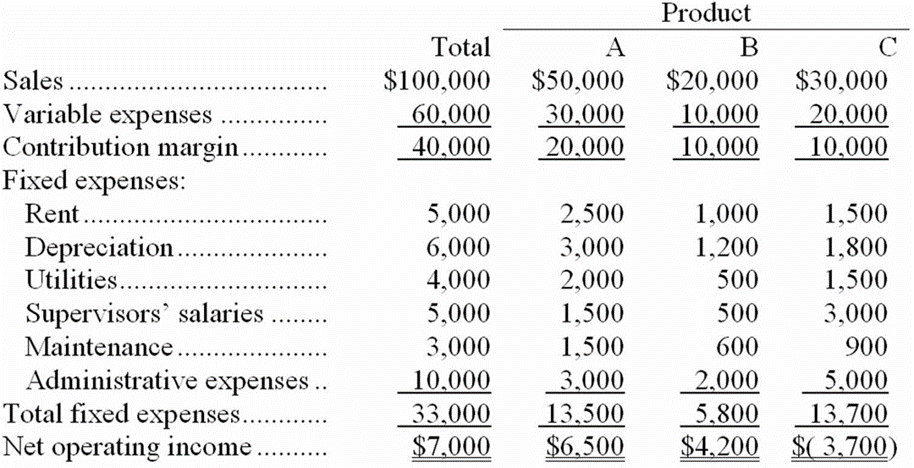
The following additional information is available:
* The factory rent of $1,500 assigned to Product C is avoidable if the product were dropped.
* The company’s total depreciation would not be affected by dropping C.
* Eliminating Product C will reduce the monthly utility bill from $1,500 to $800.
* All supervisors’ salaries are avoidable.
* If Product C is discontinued, the maintenance department will be able to reduce monthly expenses from $3,000 to $2,000.
* Elimination of Product C will make it possible to cut two persons from the administrative staff; their combined salaries total $3,000.
Required:
Prepare an analysis showing whether Product C should be eliminated. ( 1.5 Marks )
Answer ……..
Explain why the publication in Refereed journal articles is more difficult than Professional journal articles.
Assignment (3)
Deadline: Saturday 27/11/2021 @ 23:59
| Course Name: | Student’s Name: |
| Course Code: ACCT403 | Student’s ID Number: |
| Semester: 1st | CRN: |
| Academic Year: 1443 H |
For Instructor’s Use only
| Instructor’s Name: | |
| Students’ Grade: /5 | Level of Marks: High/Middle/Low |
Instructions – PLEASE READ THEM CAREFULLY
The Assignment must be submitted on Blackboard (WORD format only) via allocated folder.
Assignments submitted through email will not be accepted.
Students are advised to make their work clear and well presented, marks may be reduced for poor presentation. This includes filling your information on the cover page.
Students must mention question number clearly in their answer.
Late submission will NOT be accepted.
Avoid plagiarism, the work should be in your own words, copying from students or other resources without proper referencing will result in ZERO marks. No exceptions.
All answers must be typed using Times New Roman (size 12, double-spaced) font. No pictures containing text will be accepted and will be considered plagiarism.
Submissions without this cover page will NOT be accepted.
Assignment Questions (5Marks)
Question 1. (2 Marks)
Explain interview methods and the areas of concern in conducting them. Give example for each method.
Question 2. (1 Mark)
Q2. What are the characteristics of a good sample?
Question 3. (2 Marks)
Q4. Explain why the publication in Refereed journal articles is more difficult than Professional journal articles.
Discuss the three primary methods used by Guaranty Fund to assess property and liability insurance using your own words.
College of Administrative and Financial Sciences
Assignment 3
Deadline: 27/11/2021@ 23:59
| Course Name: Insurance Accounting | Student’s Name: |
| Course Code: ACCT 424 | Student’s ID Number: |
| Semester: 1 | CRN: |
| Academic Year: 1443/1442 H |
For Instructor’s Use only
| Instructor’s Name: Habiba Moabber | |
| Students’ Grade: Marks Obtained/Out of 5 | Level of Marks: High/Middle/Low |
Instructions – PLEASE READ THEM CAREFULLY
- The Assignment must be submitted on Blackboard (WORD format only) via allocated folder.
- Assignments submitted through email will not be accepted.
- Students are advised to make their work clear and well presented, marks may be reduced for poor presentation. This includes filling your information on the cover page.
- Students must mention question number clearly in their answer.
- Late submission will NOT be accepted.
- Avoid plagiarism, the work should be in your own words, copying from students or other resources without proper referencing will result in ZERO marks. No exceptions.
- All answered must be typed using Times New Roman (size 12, double-spaced) font. No pictures containing text will be accepted and will be considered plagiarism).
- Submissions without this cover page will NOT be accepted.
Assignment Question(s):
Q1. The following financial transactions are related with a General Takaful Product:
i. An amount of SAR 6,200 received as advanced contribution from new participants.
ii. An amount of SAR 4,500 received as a contribution from new participants.
iii. Contribution renewal received from participants SAR 5,500.
You are required to prepare necessary journal entries. (1.5 Marks)
Answer:
Q2. Discuss the three primary methods used by Guaranty Fund to assess property and liability insurance using your own words. (2 Marks)
Answer:
Q3. XYZ Company has the following financial data: (1.5 marks)
| Particulars | Amounts (SAR) |
| Total Profit for the Year | 377,500 |
| General Takaful Assets (Year 2014) | 1,390,000 |
| General Takaful Assets (Year 2015) | 1,517,500 |
| Cash | 11,500 |
| Short-term Investment | 23,500 |
| Short term liabilities | 85,000 |
| Underwriting Surplus Distributable to Participants/Participants’ Share of Profit | 145,500 |
| Gross Contribution | 958,000 |
| Net Contribution | 662,500 |
| Wakalah Fee | 77,500 |
| Commission Paid | 28,300 |
| Management Expense | 58,000 |
| Net Claim Incurred | 287,500 |
| Earned Contribution | 632,500 |
You are required to calculate:
- Return on Assets
- Quick Liquidity
- Surplus Distribution Ratio
- Expense Ratio
- Claims Ratio
Answer:
Discuss Accounting requirements
Assignment (3)
Deadline: Saturday 27/11/2021 @ 23:59
| Course Name: GNP Accounting | Student’s Name: |
| Course Code: ACCT 321 | Student’s ID Number: |
| Semester: 1st | CRN: |
| Academic Year: 1443 H |
For Instructor’s Use only
| Instructor’s Name: | |
| Students’ Grade: /5 | Level of Marks: High/Middle/Low |
Instructions – PLEASE READ THEM CAREFULLY
The Assignment must be submitted on Blackboard (WORD format only) via allocated folder.
Assignments submitted through email will not be accepted.
Students are advised to make their work clear and well presented, marks may be reduced for poor presentation. This includes filling your information on the cover page.
Students must mention question number clearly in their answer.
Late submission will NOT be accepted.
Avoid plagiarism, the work should be in your own words, copying from students or other resources without proper referencing will result in ZERO marks. No exceptions.
All answers must be typed using Times New Roman (size 12, double-spaced) font. No pictures containing text will be accepted and will be considered plagiarism.
Submissions without this cover page will NOT be accepted.
Assignment Question(s): (Marks 5)
Q.1 Art on Wheels is a newly formed not-for-profit corporation. Its purpose is to promulgate public appreciation of 19th century Saudi artists. It plans to solicit works of art from donors and to display them both in a museum and in a specially constructed bus that will travel throughout the country. It establishes a written policy to collect works of art, exhibit them, and protect them from harm. Its policy also calls for selling donated works of art that do not meet its stated objective of enhancing appreciation of 19th century Saudi artists. Proceeds from those sales will be used either to purchase works that meet its objectives or, when necessary, to defray the expenses of displaying the works.
Required: Discuss the accounting requirements (including available options)
(a) recognizing revenues and assets resulting from donations of works of art, and
(b) depreciation of art works. (Marks 0.5)
Q2. Malaz Township decides to construct a new city hall. Based on the following data, prepare a statement of revenues, expenditures, and changes in fund balance for Malaz Township’s Capital Projects Fund. All transactions occur within the calendar year 2020.
a. The Fund starts and ends the year with a zero fund balance.
b. The Fund’s financing sources for the city hall project were long-term bond proceeds – $6 million; operating transfer from the General Fund – $2 million; state grant – $1.5 million; interest from the temporary investment of cash – $90,000.
c. Total outlays for constructing the new city hall were construction costs – $8,250,000; design and construction supervision fees – $600,000.
d. City laws require that, whenever bonds are used, any remaining difference between total financing sources and construction costs must be transferred to the Debt Service Fund. Therefore, $740,000 was transferred to the Debt Service Fund.
(Mark 1.5)
Q.3 Whitt Valley Hospital is a not-for-profit initial care facility. Prepare a Statement of Operations for Whitt Hospital using the following information for its calendar year ending December 31, 2016:
Third-parties and direct-pay patients were billed $6,500,000 at the hospital’s established billing rates
The hospital determined that certain of its patients qualified for charity care and that it would not seek to collect $950,000 at established billing rates from direct-pay patients
The hospital estimated contractual adjustments for the year, including year-end adjustments of $1,600,000
The hospital estimated uncollectible amounts from direct-pay patients to be $250,000
The hospital received capitation premiums of $2,500,000. It estimated that the cost of providing this care was $1,800,000
The hospital reported salaries and wages of $4,500,000 for the year
The fair value of investments held by the hospital increased by $25,000
The hospital reported interest and dividend income of $100,000
The hospital used $375,000 of temporarily restricted resources to purchase capital assets, consistent with the restrictions imposed by the donor
The hospital reported depreciation expense of $475,000
The hospital used supplies inventories of 365,000
The hospital incurred other operating expenses of $275,000
Chapter-13 – (Marks 1.5)
Q.4 KK Building Construction receives an annual appropriation to perform construction activities. KKBC does not use commitment accounting; instead, it obligates funds upon the award of contracts Prepare budgetary and proprietary journal entries to record the following transactions.
a. KKBC received an appropriation of $10,00,000.
b. The Office of Management and Budget apportioned $400,000 of the appropriation to the Department of Domestic Construction, which oversees the KKBC
c. The Department allotted the entire $400,000 apportionment to the KKBC.
d. KKBC awarded a building construction contract for $250,000.
Ch-11 (Marks 1)
Q5. What are the financial statement and financial condition analysis indicators for liquidity ratios? (Marks 0.5)
Discuss the strength and weakness of Sensitivity Approach.
Assignment (3)
Deadline: Saturday 27/11/2021 @ 23:59
| Course Name: Accounting of Financial Institutions | Student’s Name: |
| Course Code: ACCT 405 | Student’s ID Number: |
| Semester: 1st | CRN: |
| Academic Year: 1443 H |
For Instructor’s Use only
| Instructor’s Name: | |
| Students’ Grade: /5 | Level of Marks: High/Middle/Low |
Instructions – PLEASE READ THEM CAREFULLY
- The Assignment must be submitted on Blackboard (WORD format only) via allocated folder.
- ASSIGNMENTS SUBMITTED THROUGH EMAIL WILL NOT BE ACCEPTED.
- Students are advised to make their work clear and well presented, marks may be reduced for poor presentation. This includes filling your information on the cover page.
- Students must mention question number clearly in their answer.
- Late submission will NOT be accepted.
- Avoid plagiarism, the work should be in your own words, copying from students or other resources without proper referencing will result in ZERO marks. No exceptions.
- All answers must be typed using Times New Roman (size 12, double-spaced) font. No pictures containing text will be accepted and will be considered plagiarism.
- Submissions without this cover page will NOT be accepted.
Assignment Question(s): (Marks 5)
- Accounting for Securitization under SFAS No. 140 (2000) is a limited attempt to describe complex transactions that are structured to yield desired economic and accounting outcomes. This accounting raises three issues for users of financial reports. State these three issues.
(1.5 Marks)
- The vast majority of SPEs are VIEs, however VIEs need not be SPEs. Explain this statement. Also state the conditions that define an entity as VIE. (0.5 + 1.5 Marks)
- The sensitivity approach requires that the firm provide an estimate of the loss of value, earnings, or cash flow caused by a specific adverse movement in each market price or rate. Sensitivity Approach also has some strength and some weakness. Discuss the strength and weakness of Sensitivity Approach. (1.5 Marks)
Discuss the Bullwhip effect
Discuss the Bullwhip effect. Its reasons and how it can be reduced?
– please use your own words don’t copy and paste (no plagiarism)
– I want answer with APA reference , references at least 2
– the answer should be with total 250 to 350 words
-the answer must be in a word document
Requirements: 250 to 350 words
Describe the main considerations in estimating the cost of (a) materials, (b) labor, and (c) equipment.
ESTIMATING COST FOR MATERIALS, LABOR, AND EQUIPMENT
- Describe the main considerations in estimating the cost of (a) materials, (b) labor, and (c) equipment. As an estimator, what input data you need to prepare estimates in each of these categories.
- Then, assume that you have been assigned as a cost estimation supervisor to review the work outcome of your team. Your team has prepared materials, labor and equipment estimates for a construction project. How you would review and assess their work and what elements do you evaluate to ensure they have exercised due diligence in preparing the estimates.
Provide a minimum of a four-page narrative (the four pages exclude the cover page and reference page that you have to provide). Of the four pages, two pages should be dedicated to Numbered Item 1 in the above instruction and two pages should be dedicated to Numbered Item 2 in the above instruction. Properly organize your work and add headings and subheadings in your narrative matching the numbered items outlined above (Numbered Items 1a, 1b, 1c, and 2). Support your statements and conclusions using the textbook, and at least two scholarly, peer-reviewed articles published in the most recent ten years.
What ethical, legal, and regulatory considerations do you face or expect to face in practice?
Please identify a practice-related process or issue within your work setting you believe is in need of improvement or change.
Discuss why you feel this process or issue should be changed.
What ethical, legal, and regulatory considerations do you face or expect to face in practice? Be sure not to post any identifying information when discussing patient-related scenarios.
Requirements: 175 words
Compare the emissions of biodiesel blends with the emissions from ethanol blends. Which produces more SOx and NOx? Which produces more CO?
Research Project (Online version): Testing Biodiesels
As the economic (and environmental) cost of fossil fuels becomes increasingly problematic, the need to shift toward alternative forms of energy is gaining popularity. One promising new form of energy can be found in biodiesel, which can use various natural products and even waste to generate fuels to heat our homes, power our vehicles and charge our phablets. The process of generating biodiesel involves a reaction called transesterification, whereby fats and oils which contain a high percentage of triglycerides, are broken down into glycerol and fatty acid methyl esters (FAMEs). The process is shown below:
Biodiesel production: Transesterification of triglycerides (fats) to fatty acid methyl esters (FAMES)
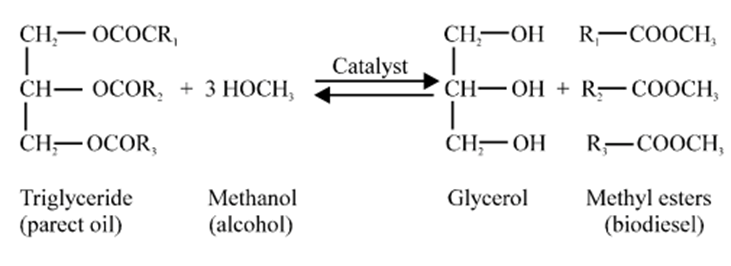
A triglyceride is composed of 3 ester, functional groups. The process of transesterification involves treatment of triglycerides with methanol (an alcohol) in the presence of an acid or base catalyst, the original ester bonds are broken and new ester bonds are formed. Thus the original ester (triglyceride) is broken and the resulting methyl esters are derived from reaction of methanol with the 3 fatty acid chains. While the original triglyceride is too viscous to work in a conventional car engine, the resulting methyl esters are more volatile and can be combusted in slightly modified, conventional engines. Fatty acid methyl esters (FAMES) are very flammable with a rather low flash point while their free fatty acid (FFA) counterparts have much higher melting points and higher flash points, making them less desirable as fuels. Thus, biodiesel synthesis must be carried out in a way that minimizes formation of free fatty acids while maximizing the breaking of ester bonds in the triglyceride. This is best done in anhydrous environment using dry solvents under inert atmosphere such as Ar. However, such an environment can be expensive to produce and outweigh the benefits of the gain in reaction efficiency.
PART I. Background on biofuel terminology, uses and materials.
Purpose
- Become familiar with scientific language relevant to this field.
- Develop practical analysis skills using data and figures related to biofuel synthesis.
- Use background literature to identify the knowledge gaps and areas for future work in a given scientific field.
- Create your own ideas and research goals related to optimizing biodiesel use.
Task: Use this publication in PNAS to answer the following questions
- Notice this article refers to 2 major biofuels, ethanol and biodiesel. What are the main crops used to produce these biofuels?
- Define the term “Net Energy Balance”? Is it more desirable to have a positive or negative NEB? Why?
- Evaluate figure 1. Compare the NEB of corn based and soybean based biofuels. Which has a more desirable NEB?
- What is DDGS and soybean mean and how do these contribute to the net energy balance?
- Life cycle environmental effects. This section of the paper compares the pesticide consumption and emissions of different biofuels.
- Which biofuel consumes more pesticide? What is the impact of this pesticide usage on the Gulf of Mexico?
- Compare the emissions of biodiesel blends with the emissions from ethanol blends. Which produces more SOx and NOx? Which produces more CO?
- Potential US Supply. This section of the paper discusses the problems with off-setting fossil fuel productions with corn or soybean based biofuels.
- How do soybean based biodiesel and corn based ethanol usage compare to fossil fuel usage in the US?
- By what percentage could fossil fuel consumption be reduced if all soybean and corn were converted to biofuels?
- Your opinion: What are the major obstacles to reducing fossil fuel consumption through use of biofuels? What are some possible strategies to increase the use of biofuels relative to fossil fuels?
Rubric for part I
| 5 pts Scientist Fulfills criteria for score level 4. Answers draw out more than the obvious meaning. Thorough analysis provided in explaining the major obstacles to wide-scale biodiesel use. | 4 pts Research Fellow Answers illustrate clear grasp of academic language used in relevant literature. Analysis includes original thought related to potential problems with biodiesel productions and use. | 3 pts Lab technician Accurately answers all questions but provides few insights and personal reflections. | 2 pts Lab aide Assignment is generally incomplete, and answers reflect very little thought or effort. | 1 pts Developing Large omissions/many unanswered questions. |
Part II. Hypothesis and method formulation.
Purpose: In Part I you explored the relevant literature, introducing you to the academic language, data types and knowledge gaps in the field of biofuel development. In part II, you will build on this by formulating your own hypothesis and method related to biodiesel production, consumption or waste products. As part of this method, be sure to include build appropriate controls, as we have discussed in the past.
Task: Formulate a hypothesis and research question. For background on the difference between a research question and hypothesis, read “Research Questions, Hypotheses and Objectives written by Patricia Farrugia et al. the reading by Farrugia, 2010 (source linked below). The hypothesis should include a statement of rationale to justify why you have chosen to study your chosen independent and dependent variables. Notice that below Task 2, in this document, is a “Basic protocol” that suggests potential independent and dependent variables for you to choose. You can use any of these variables or choose your own.
Task: Formulate a method to test this hypothesis. To format your method, use the article by Wenying Shi and coworkers titled “Biodiesel production from waste chicken fat with low free fatty acids by an integrated catalytic process of composite membrane and sodium methoxide.” A .pdf of this article is also attached to the Canvas assignment. Use this as a guide for depth and style in writing your method. In particular, pay attention the level of detail in the method. There is a skill to writing scientific methods, it is possible to have both too much and too little detail. The abstract and introduction to the paper by Shi will also discuss more about the molecular structure of biodiesel, the methods for preparing biodiesel and some of the challenges facing researchers who are looking to use biodiesel as a clean-burning, renewable replacement for fossil fuels. In this process, you will also need to seek out additional resources such as your textbook, instructor or classmates for help understanding background information. A BC librarian has also provided you with a module to introduce you to browsing literature sources for use in formulating a research question and hypothesis.
In addition, all of the recommended resources and searching techniques may be found at: https://bellevuecollege.libguides.com/CHEM162.
Basic Protocol (Use this link to see a video demonstration of the basic protocol from MCC Alt Fuels)
- Make sure all glassware is clean and dry
- Dissolve approximately 2.25 g of NaOH in 50.0 mL of methanol in an Erlenmeyer flask.
- Independent variable option: This may be a step you want to modify for your experiment. Do you want to try a different catalyst? Do you want to change the reaction conditions in some way?
- Experimental note: You should be able to determine the appropriate equipment for these mass and volume measurements. Also, you should be able to explain why we are using an Erlenmeyer flask instead of a beaker for this step).
- Experimental note: If you do not add exactly 2.25 g of NaOH or exactly 50.0 mL of methanol this will not cause error in this experiment. Why not? You should make sure to record exactly how much NaOH and methanol that you do add, why is this important?
- Cover flask with a watch glass and stir until the NaOH dissolves (you have now produced sodium methoxide).
- Independent variable option: You may want to compare how KOH compares to NaOH as catalysts for this reaction.
- Experimental note: Determining how to stir this, safely, is the responsibility of the scientist. Note that using a glass stir rod is labor intensive but still considered stirring.
- Add 225 g of vegetable oil to a separate Erlenmeyer flask.
- Independent variable option: This may be a step you want to modify for your experiment. Do you want to try a different feedstock?
- Experimental note: Does it matter if you use exactly 250.0 mL of vegetable oil? What is something you should do after making this measurement?
- Experimental note: Be sure to fully think through your protocol before you perform it. Notice what you will be doing in the next step. Use this information to determine which Erlenmeyer flask to use here. Should you record which piece of glassware you actually used?
- Slowly and carefully add the sodium methoxide solution to the vegetable oil. Heat this mixture to 55-60 oC with stirring for about 45 minutes (How will you stir this?).
- Pour mixture into a separatory funnel and let sit for about 10-15 minutes. Make sure the stopcock is closed before adding your mixture to the funnel. The separatory funnel will allow for separation of the glycerol (d = 1.26 g/mL) from the biodiesel (d ≈ 0.85 g/mL). Make sure to record your observations here.
- Slowly drain the glycerol layer into a small beaker by turning the stop cock.
- Drain the crude biodiesel into a clean container to save for later use.
- Experimental note: You will need to wash this biodiesel you will be able to use it in your vehicle.
Possible dependent variables
- Dependent variable to measure: Fuel value.
- You have already designed a protocol for testing the heat of combustion of your fuel. This is one protocol you might use to test your hypothesis.
- Dependent variable: Products of combustion
- Collect the exhaust from combustion of your fuel. Analyze this exhaust for different components including carbon dioxide, carbon monoxide and soot.
- Dependent variable: Efficiency of transesterification reaction.
- Use GCMS to measure the products of your reaction. This would be useful if you were testing different catalysts or reaction conditions for biodiesel preparation.
- Dependent variable of your choice: Discuss with instructor.
What you will submit for Part II:
- A research question and hypothesis, submitted electronically to Canvas. Make sure your question and hypothesis follow the guidelines outlined by Farrugia. Notice that the basic protocol contains suggestions for independent and dependent variables to consider in formulating your hypothesis. Please choose one of the independent and dependent variables suggested. If you would like to design your own independent and dependent variable please make sure that this experiment will be feasible given the equipment available.
- A 2 paragraph statement of rationale, or introduction containing background information supporting your hypothesis. This introduction should cover the overall goal of synthesizing and testing biodiesel and eventually describe the focused, scientific question you hope to answer.
- A method outlining the steps taken to prepare and to test biodiesel. Make sure this procedure contains statements of rationale for each step. The purpose of this procedure is so that in the future, you can exactly replicate the product of this procedure. This method should also clearly identify any negative and positive controls to ensure that your dependent variable is only responding to your independent variable and that you are able to adequately measure this response.
Rubric for part II
Hypothesis and rationale
| 5 pts Scientist Fulfills criteria for score level 4. Analysis of chosen variables will draw out novel conclusions. | 4 pts Research Fellow Hypothesis addresses relevant problems identified by literature sources. Literature sources are primarily of high quality. | 3 pts Lab technician Hypothesis attempts to address relevant problems identified by valid literature sources and/or literature sources are of moderate quality | 2 pts Lab aide Hypothesis asks question that is poorly supported by literature sources and/or literature sources are of poor quality and/or proposed data collection is impossible or impractical. | 1 pts Developing Hypothesis does not directly propose a question for study and/or hypothesis is not supported by valid literature sources and/or data collection would be impossible or dangerous. |
Method development
| 5 pts Scientist Fulfills criteria for score level 4. Formulates method based on forming multiple connections between literature, preliminary observations and theory. Results of proposed project will likely result in advancement of the field. | 4 pts Research Fellow Method controls for variables by considering background literature, preliminary observation and scientific principles. Makes all relevant connections between each of these components. Proposed study is feasible and likely to result in useful results. | 3 pts Lab technician Proposed study has obvious limitation that make data collection difficult and interpretation problematic. Presentation is generally organized. | 2 pts Research Assistant Few connections made between scientific principles and procedure/data/observations. Data will lead to biased conclusions that can’t quantitatively link the dependent variable to the independent variable.. | 1 pts Developing Method appears random and without rationale. Potential collected data do not relate to hypothesis. |


