


Describe the roles of the nurses in disaster planning and actual disasters.
Disaster Planning for Your Unit
You are a nurse manager in charge of developing a disaster plan for your unit. As the manager, you will need to include the influential agencies, stakeholders and the roles of the nurses in disasters.
First Post
Identify the influential agencies and stakeholders you would include in your plan. Describe the roles of the nurses in disaster planning and actual disasters. How would you ensure the nurses on the unit understand their roles in the disaster plan?
Methods of Managing the Culture
Choose 2 national companies and 2 international companies. Then, discuss and explain the 4 Methods of Managing the Culture for each one of those companies? Note, Do not use (Apple, Amazon, Noon and cream)
Creating an effective project team
An effective project team is not born spontaneously; it must be created. How would you go about creating an effective project team? What would constitute and be included in a good team-building process?270-300 wordsPlease provide a refernce(s)
cancer patient
write a1 page professional doctor’s note excusing a person from work due to her father having cancer
Highly innovative firm
Describe a firm you think has been highly innovative. Which of the four types of innovation— radical, incremental, disruptive, or architectural – did it use? Did the firm use different types over time? Please provide a reference with the answer
Divorce and taxes.
An article is linked below, regarding divorce and taxes. Your client has asked for insights regarding marriage and taxes as her nuptials are soon. Please write a 300 word letter to your client recommending a prenuptial or just advising her as to tax considerations before the “I do.” Consider the posted article. Full credit will be earned only if other works are cited. You can use any search engine and your text.
Objectives and constraints
ASSIGNMENT
Project Portfolio Management at Novartis
This case describes the R&D project selection and prioritization process at Novartis Pharmaceutical, a recurrent issue of strategic importance to the firm. In the pharmaceutical industry, project portfolio decisions are crucial to the viability and success of a company, and require huge investment commitments.
IMPORTANT: The spreadsheets “Novartis-Oncology.xls” and “NovartisAll.xls” (posted in Canvas under Session 12) contain the relevant data for the R&D projects in the Oncology therapeutic area and R&D projects in all areas respectively.
Questions
- Framing the project portfolio management problem.
(a) What are the objectives and constraints? What are the risks involved? What are the firm’s alternatives?
(b) What information is required for making these decisions? How can it be collected? - Consider the following project (“Project 1”) in Novartis’ portfolio, a project in the pre-clinical phase, part of the Oncology therapeutic area.
Project 1 Phase Pre-Clinical Launch Year 2009 Probability of Technical Success 5% Net Sales (if success) $4,753 million Pre-launch costs (including R&D cost) $152 million
(a) What is the value of this project?
(b) Would you execute this project?
(over)
OMM 500D, Chayet Project Portfolio Management 2 - Project Risk
(a) How would you assess the technical (technology) risk of Project 1?
(b) How would you assess the market (commercial) risk of Project 1? - (a) Suppose that next year’s R&D budget for the Oncology area has been reduced to $50 million. How would you decide which projects to continue, and which to put on hold?
(b) Suppose that the following R&D budgets have been set for next year for each of the different therapy areas: • Oncology: $100 million • Cardiovascular: $200 million • Respiratory & Dermatology: $150 million • Transplantation: $100 million • Rheumatology, HRT: $300 million • Central Nervous System: $100 million • Ophthalmic: $50 million How would you decide which projects to continue, and which to put on hold?
Reasons for Salim’s disillusionment
In September 2018, Mohammed Salim joined KAAF Software Solutions (KAFF) as a Senior Programmer, with a handsome pay. Prior to this job, he worked successfully as an Assistant Programmer in Gant Computers (Gant). Salim felt that working for KAFF, there are better career prospects, as it was growing much faster than Gant, which was a relatively small company.
Although Salim had enjoyed working there (at Gant), he realized that to grow further in his field, he would have to join a bigger company, and preferable one that handled international projects. He was sure he would excel in his position at KAFF, just as he had done in his old job at Gant.
KAFF had international operations and there was more than a slim chance that he would be sent to USA or the UK on a project. Knowing that this would give him a lot of exposure, besides looking good on his resume, Salim was quite excited about his new job.
Salim joined Mrs. Zeenat’s five-member team at KAFF. He had met Mrs. Zeenat during the orientation sessions, and was looking forward to working under her. His team members seemed warm and friendly, and comfortable with their work. He introduced himself to the team members and got to know more about each of them.
Wanting to know more about his boss, he casually asked one of the team members, about Mrs Zeenat. He was told that Mrs. Zeenat does not interfere with our work. Salim was surprised to know this and thought that probably Mrs. Zeenat was leaving them alone to do their work without any guidance, in order to allow them to realize their full potential.
At Gant, Salim had worked under Abdulrahman and had looked up to him as a guide and mentor – always guiding, but never interfering. Abdulrahman had let Salim make his own mistakes and learn from them. He had always encouraged individual ideas, and let the team discover the flaws, if any, through discussion and experience. He rarely held an individual member of his team responsible if the team as a whole failed to deliver – for him the responsibility for any failure was collective. Salim remembered telling his colleagues at Gant that the ideal boss would be someone who did not interfere with his/her subordinate’s work. Salim wanted to believe that Mrs. Zeenat too was the non-interfering type. If that was the case, surely her non-interference would only help him to grow.
In his first week at work, Salim found the atmosphere at the office a bit dull. However, he was quite excited. His team had been assigned a new project and was facing a few glitches with the new software. He had thought about the problem till late in the night and had come up with several possible solutions. He could not wait to discuss them with his team and Mrs. Zeenat. He smiled to himself when he thought of how Mrs. Zeenat would react when he will tell her that he had come up with several possible solutions to the problem. He was sure she would be happy with his having put in so much effort into the project, right from day one.
He was daydreaming about all the praise that he was going to get when Mrs. Zeenat walked into the office. Salim waited for her to go into her cabin, and after five minutes, called her up, asking to see her. She asked him to come in after tem minutes. When he went in, she looked at him blankly and asked, “Yes?” Not sure whether she had recognized him, Salim introduced himself. She said, “Ok, but why did you want to meet me?” He started to tell her about the problems they were having with the software. But before he could even finish, she told him that she was busy with other things, and that she would send an email with the solution to all the members of the team by the end of the day, and that they could then implement it immediately. Salim was somewhat taken aback. However, ever the optimist, he thought that she had perhaps already discussed the matter with the team.
Salim came out of Mrs. Zeenat’s cabin and went straight to where his team members sat. He thought it would still be nice to bounce ideas off them and also to see what solutions others might come up with. He told them of all the solutions he had in mind. He waited for the others to come up with their suggestions but not one of them spoke up. He was surprised, and asked them point-blank why they were so disinterested.
Faisal, one of the team members, said, “What is the point in our discussing these things? Mrs. Zeenat is not going to have time to listen to us on discuss anything. She will just give us the solution she thinks is best, and we will just do what she tells us to do; why waste everyone’s time?”
Salim felt his heart sink. Was this the way things worked over here? However, he refused to lose heart and thought that maybe, he could change things a little. But as the days went by, Salim realized that Mrs. Zeenat was the complete opposite of his old boss.
While she was efficient at what she did and extremely intelligent, she had neither the time nor the inclination to groom her subordinates. Her solutions to problem were always correct, but she was not willing to discuss or debate the merits of any other ideas that her team might have. She did not hold the team down to their deadlines not did she ever interfere. In fact, she rarely said anything at all. If work did not get finished on time, she would just blame her team, and totally disassociate herself from them.
Time and again, Salim found himself thinking of Abdulrahman his old boss, and of how he had been such a positive influence. Mrs. Zeenat, on the other hand, even without actively doing anything, had managed to significantly lower his motivation levels.
Salim gradually began to lose interest in his work – it had become too mechanical for his taste. He didn’t really need to think; his boss had all the answers. He was learning nothing new, and he felt his career was going nowhere. As he became more and more discouraged, his performance suffered. From being someone with immense promise and potential Salim was now in danger of becoming just another mediocre techie.
Questions:
Q1. What, according to you, were the reasons for Salim’s disillusionment? Answer the question using Maslow’s Hierarchy of Needs. (2.5 marks)
Q2. What should Salim do to resolve his situation? (1.25 marks)
Q3. What should a team leader do, to ensure high levels of motivation among his/her team members? (1.25 Marks)
slide presentation on federal corporate income tax rates
The topic is:
US federal corporate income tax rates: where have they been and where are they going?
multiple regression model
SPSS Chapter 14
14.26 This exercise requires the use of a computer pack- age. The article “Movement and Habitat Use by Lake Whitefish During Spawning in a Boreal Lake: Inte- grating Acoustic Telemetry and Geographic Informa-tion Systems” (Transactions of the American Fisheries
Society [1999]: 939–952) included the accompanying data on 17 fish caught in 2 consecutive years.
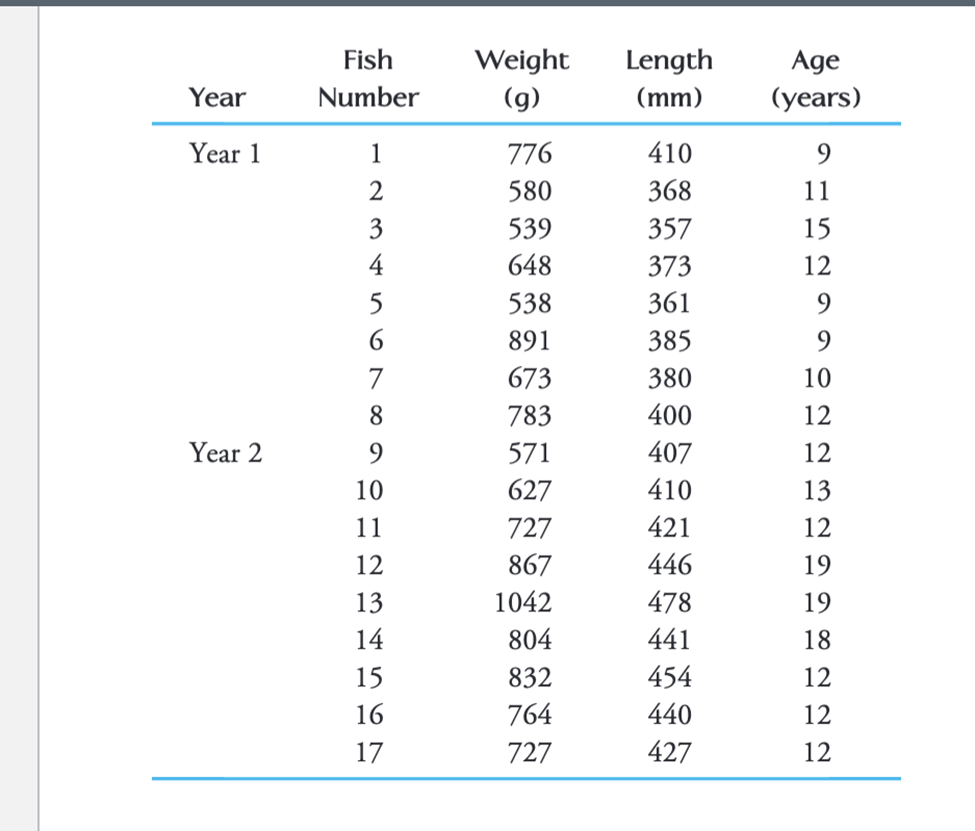
a. Fit a multiple regression model to describe the rela-tionship between weight and the predictors length and age. y^5 2 511 1 3.06 length 2 1.11 age
b. Carry out the model utility test to determine whether at least one of the predictors length and age are useful for predicting weight.
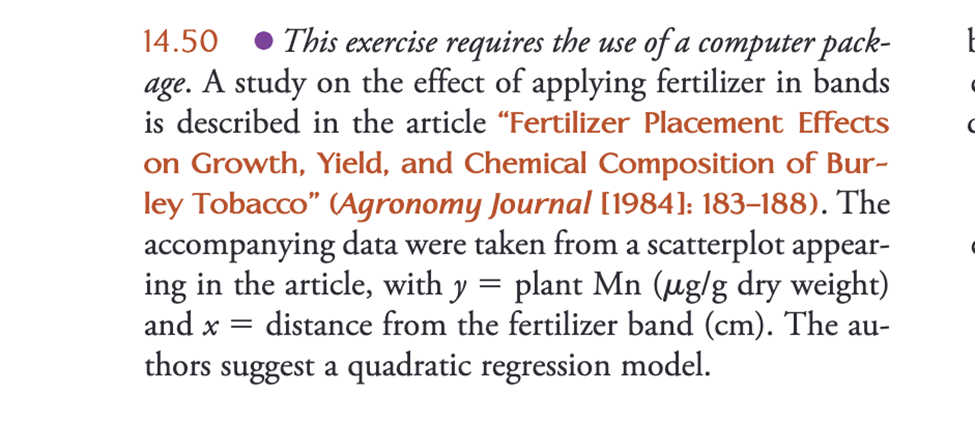
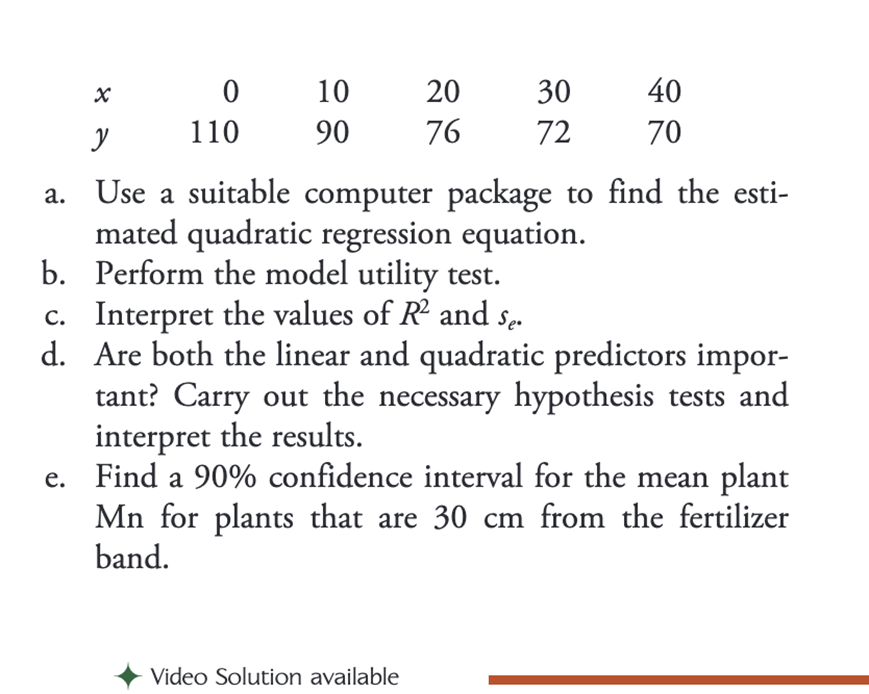
14.50

| Y | X1 | X2 | X3 | X4 | X5 |
| 17 | 6.7 | 0.5 | 4 | 10 | 50 |
| 42 | 7.8 | 1.0 | 4 | 24 | 30 |
| 1 | 9.9 | 1.2 | 4 | 17 | 120 |
| 11 | 10.1 | 0.5 | 4 | 23 | 30 |
| 8 | 10.0 | 0.9 | 4 | 18 | 20 |
| 30 | 8.7 | 0.8 | 4 | 9 | 160 |
| 2 | 10.3 | 1.5 | 4 | 13 | 40 |
| 6 | 10.5 | 0.3 | 4 | 10 | 150 |
| 11 | 11.0 | 1.2 | 3 | 9 | 50 |
| 14 | 11.2 | 0.6 | 3 | 7 | 100 |
| 53 | 12.9 | 1.8 | 3 | 10 | 90 |
| 9 | 13.2 | 0.2 | 3 | 12 | 50 |
| 4 | 16.2 | 0.7 | 3 | 6 | 80 |
| 3 | 15.8 | 1.6 | 3 | 7 | 120 |
| 7 | 16.2 | 0.4 | 3 | 10 | 50 |
| 9 | 15.8 | 1.2 | 3 | 9 | 60 |
| 10 | 16.0 | 0.8 | 3 | 12 | 90 |
| 7 | 16.2 | 1.2 | 3 | 5 | 160 |
| 12 | 17.1 | 0.7 | 3 | 10 | 90 |
| 12 | 17.5 | 0.8 | 3 | 12 | 110 |
| 26 | 17.5 | 1.2 | 3 | 18 | 130 |
| 14 | 17.4 | 0.8 | 3 | 9 | 60 |
| 18 | 17.4 | 1.1 | 3 | 13 | 30 |
| 14 | 17.8 | 0.5 | 3 | 8 | 160 |
| 5 | 18.0 | 1.6 | 3 | 10 | 40 |


